While the EU fiddled and bought oil from Russia, Ukraine burned. Trump wants to clean up the mess - and prevent future wars. Of course EU leaders don't like him. But they need him.
Davos is where the world’s self-appointed guardians gather each winter to reassure each other that everything is under control — right up until it isn’t. It’s where people toast “stability” with expensive champagne while the map catches fire.
The consequences have become too obvious to ignore.
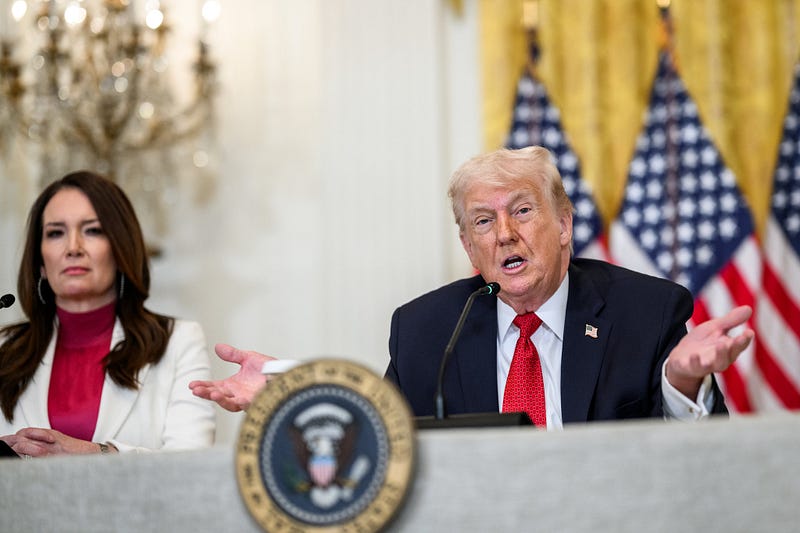
This year, Donald Trump walked into that room like a weather event.
He opened with the swagger you’d expect — part boast, part provocation, part showman — but also with a message that was unmistakably strategic: the era of free-riding is over. Not just in trade. In energy. In borders. And most especially in security.
And then he pivoted to the topic Europe can’t escape, even when it wants to: the West’s weakening posture, and what that weakness invites.
Scratch that: What it has already invited.
“The consequences of such destructive policies have been stark,” he said, “including lower economic growth, lower standards of living, lower birth rates, more socially disruptive migration, more vulnerability to hostile foreign adversaries, and much, much smaller militaries.”
That line alone explains why so many EU leaders bristle at him. It doesn’t flatter. It indicts.
Trump’s argument — delivered in his usual blunt-force style — is that the last decade of European governance has created a continent that is softer, poorer, more divided, and more dependent. And dependency is the one thing he refuses to subsidize quietly.
“We want strong allies, not seriously weakened ones. We want Europe to be strong,” he said. “Ultimately, these are matters of national security…”
Then he dropped the word he knew would detonate in the room: Greenland.
“Perhaps no current issue makes the situation more clear than what’s currently going on with Greenland,” he said. “Would you like me to say a few words of Greenland?”
And he did. At length.
“Every NATO ally has an obligation to be able to defend their own territory,” Trump said. “And the fact is, no nation or group of nations is in any position to be able to secure Greenland other than the United States.”
Trump framed Greenland as the most literal symbol of what he says Europe has become: a region with strategic vulnerabilities it cannot secure, while assuming America will always fill the gap.
“Greenland is a vast, almost entirely uninhabited and undeveloped territory that’s sitting undefended in a key strategic location between the United States, Russia and China,” he said. “That’s exactly where it is. Right smack in the middle.”
“This enormous unsecured island is actually part of North America on the northern frontier of the Western Hemisphere,” he said. “That’s our territory.”
President Trump wasn’t subtle about the underlying point: Europe’s security architecture collapsed with its dependency on Russian oil and gas. “So now our country and the world face much greater risks than it did ever before,” he said. “Because of missiles, because of nuclear, because of weapons of warfare that I can’t even talk about.”
If you want to understand why this speech rattled European leaders, don’t get stuck on the Greenland theatrics. The real threat to the Davos consensus is his fundamental premise: Europe is living in an old story.
And Trump is insisting the plot has changed.
He bluntly linked NATO, Ukraine, and Europe’s posture in a way most leaders avoid because it’s impolite: “What does the United States get out of all of this work? All of this money other than death, destruction, and massive amounts of cash going to people who don’t appreciate what we do… I’m talking about NATO, I’m talking about Europe.”
Then he delivered the core grievance, the one that never goes away: “We give so much and we get so little in return… the United States is treated very unfairly by NATO.”
“Until I came along, NATO was only supposed to pay two per cent of GDP, but they weren’t paying,” he said. “The United States was paying for virtually 100 per cent of NATO.”
Then the escalation: “I got NATO to pay five per cent and now they were paying and now they are paying.”
It’s not that every claim here is tidy, or that the delivery is diplomatic. It’s that Trump is saying out loud what the alliance has tried to paper over: there is a widening gap between America’s expectations and Europe’s capacity.
And into that gap, the Russia-Ukraine war has been bleeding for years.
Trump’s framing of Ukraine is harsh. He recited death tolls like an accusation: “It’s a bloodbath over there,” he said. “And that’s what I want to stop. Doesn’t help the United States, but these are souls.”
Then he stated his claim of intent: “And I’m dealing with President Putin and he wants to make a deal. I believe I’m dealing with President Zelensky, and I think he wants to make a deal.”
Here is the uncomfortable truth Europe doesn’t like to hear: they may not like Trump, but they cannot replace him. Not militarily. Not economically. Not strategically.
Because whether European leaders admit it or not, America remains the keystone. Trump says it bluntly with bluster, but he’s pointing at a real structural fact: Europe’s security is still, in practice, an American project.
And Trump is telling them the terms are changing.
“But the problem with NATO is that we’ll be there for them 100 per cent,” he said, “But I’m not sure that they’d be there for us…”
That is not a sentence designed to soothe. It’s a sentence designed to force a reckoning.
“A strong and secure America means a strong NATO” — That’s the deal, in Trump’s mind. Not a sentimental alliance. A transactional one anchored in strength.
So yes — EU leaders don’t like him. Of course they don’t. He humiliates their assumptions. He mocks their sacred cows. He breaks the polite choreography. He walks into Davos and essentially says: you’ve been playing house while the world militarized.
But they need him —because he’s operating from a premise they’ve been avoiding: the West is back in an era of hard power, and moral lectures don’t stop missiles.
Trump didn’t go to Davos to be loved. He went to drag the room into reality.
And if Europe is serious about surviving what comes next, it should stop pretending it can afford to hate the only hurricane that might actually clear the air.
(Contributing writer, Brooke Bell)