"Iran has been at war with the United States for 47 years, killing Americans, targeting civilians, and spreading terror across the globe."
It’s been almost a month since the U.S. went to war against Iran.
Who is winning? When will the war end? How will international trade be impacted? What about oil prices? How will the conflict reshape the Persian Gulf and the Middle East? What will the long-term implications be? How much longer can the Iranian government, decimated and repeatedly decapitated, possibly hold out?
These and many other questions surround the conflict, with answers seeming to change on a daily basis.
President Donald Trump — who was always bound to face criticism from mainstream media outlets that tend to favor Democratic Party politicians over Republican ones anyway, and even the former Ayatollah of Iran Ali Khamenei over Donald Trump — is weathering the media storm with his customary combination of nonchalance and defiance.
And while plenty of European powers condemned U.S. action against Iran initially, some seem to have come around to Trump’s way of thinking — perhaps because countries in the Persian Gulf and throughout the Middle East have been more supportive.
It’s understandable: Gulf nations have largely borne the brunt of Iran-sponsored terrorist operations. Over the past decade in particular, starting with the appeasement era of the Obama Administration carried over into the Biden Administration, the threat from Iran has been growing exponentially.
Flush with appeasement-cash, the Iranian regime waged proxy terrorism against its neighbors and co-religionists with wild abandon. It’s the reason so many Middle Eastern nations started normalizing relations with Israel. It wasn’t ideological compatibility. It wasn’t a sudden yearning for democracy.
It was self-preservation.
Iran has long been a threat to the U.S. as well. Were it not for the ocean and thousands of miles between us, the U.S. might have suffered the same terrorist actions foisted on Israel and other Middle Eastern nations by the Iranian regime.
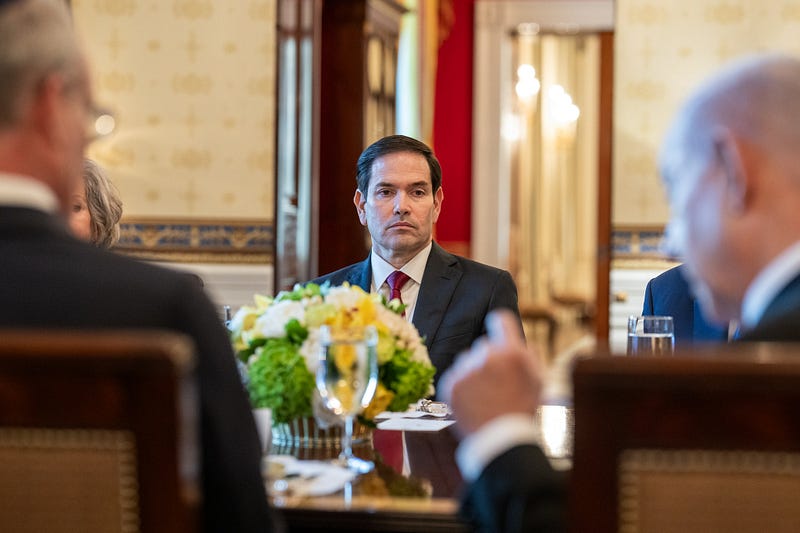
“Iran has been at war with the United States for 47 years, killing Americans, targeting civilians, and spreading terror across the globe,” Sec. Marco Rubio said this week. “Other presidents talked. This one is acting. At their weakest point, the regime is still attacking embassies and civilians.”
“Imagine what they would do with a nuclear weapon,” Rubio said.
“That risk is no longer being tolerated,” he added. “The mission is clear: destroy Iran’s naval power, eliminate its missile capabilities, and shut down its ability to produce weapons. And it is happening. This is not just about America. The world is becoming safer because someone finally chose to confront the threat instead of managing it.”
Rubio wasn’t the only one to say so.
“The Iranians have the ‘inalienable right to enrich,’” U.S. special envoy Steve Witkoff reminded the press on Wednesday. “Then we heard they possessed enough 60% enriched material, 460 kilograms, to make 11 atomic bombs. They would not give up diplomatically what we could not win militarily.”
“Jared and I both agreed that the Iranians were there to buy time until a weaker president arrived,” Mr. Witkoff said. “This was a flawed strategy… Against that backdrop and our compelling military successes in Epic Fury, we’ve had multiple reach outs from the region and others who want to play a role in ending this conflict peacefully.”
“We have… presented a 15-point action list that forms the framework for a peace deal,” Witkoff concluded.
Hopefully, Iranian leadership will accept whatever terms they can get at this point. Whatever regime spokesmen tell an overly credulous press, at this point there seems little chance the regime will survive.
(Contributing writer, Brooke Bell)