Today's protest vote could be tomorrow's governor of California.
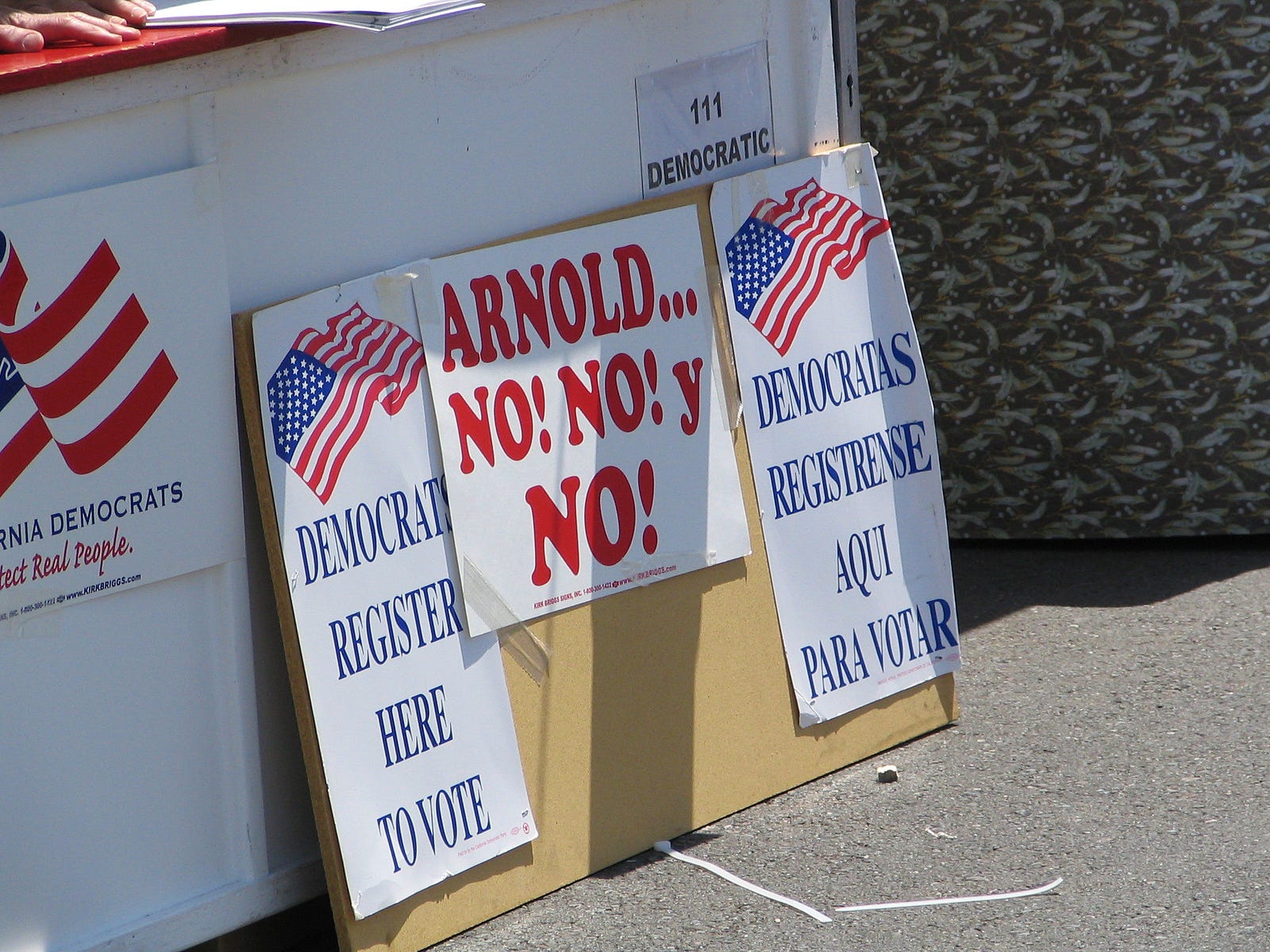
California is not red, and it may not even be purple.
But the trend line is no longer moving only in Democrats’ direction.
After years of growing Democratic dominance, California’s registration numbers show a modest but real Republican rebound. That does not make California a Republican state. It does mean Democrats can no longer assume their statewide advantage is immune to erosion.
For years, California was treated as the place where Republican political dreams went to die. The state was too blue, too expensive, too unionized, too progressive, too Hollywood, too Bay Area, too Sacramento. Republicans could win a House seat here and there. They could talk tough on crime from Orange County or the Central Valley. But statewide office? Los Angeles mayor? Governor? Forget it.
Now, maybe not.
The sudden strength of Republican candidates like Steve Hilton in the California governor’s race and Spencer Pratt in the Los Angeles mayor’s race is a bit shocking. Democrats still have an enormous registration advantage, of course. California still votes Democratic in presidential races by huge margins. The culture of the state, especially in its biggest population centers, is still deeply liberal.
But politics is not static. Voters do not live inside registration charts. They live inside neighborhoods, grocery bills, insurance crises, tent encampments, wildfire evacuation zones, broken permit systems, and cities where nothing ever seems to get cheaper, safer, cleaner, or easier.
That is where Republican opportunity begins.
California Democrats have had almost everything they said they needed. Power. Money. Supermajorities. Governors. Mayors. District attorneys. Environmental authority. Tax authority. Regulatory authority. The ability to build the future according to their own blueprint.
And yet the average Californian looks around and sees a state where houses are unaffordable, insurance is vanishing, homelessness is everywhere, crime and disorder feel worse than official charts suggest, businesses are leaving, energy is expensive, and the government still cannot seem to build basic infrastructure without turning it into a theological exercise in process, equity, consultants, and delay.
At some point, voters stop asking whether the other party is perfect. They start asking whether the people in charge deserve permanent immunity from consequences.
That is the real opening for Republicans in California.
Voters who would never call themselves Republicans may decide they are willing to vote for one. Voters who normally vote blue may decide they want a check on one-party rule. Independents may decide the Republican candidate sounds less like an ideologue and more like the only person willing to say the obvious out loud. Even some Democrats may look at Sacramento and Los Angeles and think: this is not working.
Today’s protest vote can become tomorrow’s Republican governor.
That sounds dramatic until you look at Florida.
Florida was not exactly a reliable blue state in modern presidential politics. It was the great swing state. The place where elections went to court, where Democrats could win, where Republicans could win, and where every presidential campaign spent obscene amounts of money trying to move half an inch. But Florida did have a Democratic registration advantage for years. Then, almost overnight in political terms, the ground shifted. Republicans overtook Democrats in registration in 2021. Now they have a massive advantage.
That did not happen because every Floridian woke up one morning and read Edmund Burke. It happened because one party built an identity around competence, growth, defiance, safety, parental authority, and normalcy, while the other party lost touch with too many voters on too many issues for too long.
California is not Florida. But Democrats should be careful about saying that as if history cannot rhyme.
New Jersey offered a similar warning. In 2021, Jack Ciattarelli came within a few points of defeating Phil Murphy in a deep blue state. Ciattarelli didn’t win. But close elections in blue states are political smoke alarms. They tell you something is heating up even if the house has not burned down yet.
California Democrats can still dismiss all of this, of course. They can say Steve Hilton is a Trump-backed TV guy. They can say Spencer Pratt is a reality television personality. They can say Republicans are still badly outnumbered. All true, or true enough.
But that is not the point.
The point is that voters do not need to love Republicans to punish Democrats. They only need to believe the Republican is a tolerable risk and the Democrat is a guaranteed continuation of the same failure.
That is how political change begins. Not with everyone changing their party registration. Not with the entire state waking up red. It begins with a few voters deciding they are allowed to break habit. Then a few more. Then a few more. Eventually the protest vote stops looking like protest and starts looking like a coalition.
California is still blue. But blue is not the same thing as untouchable.
If Republicans are smart, they will not run in California as national cable-news avatars. They will run as plumbers, builders, reformers, auditors, prosecutors, firefighters, permit-cutters, tax-cutters, and adults with clipboards. They will talk about the the cost of housing, the absurdity of endless environmental review, the humiliation of paying more and getting less, the families leaving, the businesses leaving, the insurance companies leaving, and the ordinary people wondering why nothing works in the richest state in the country.
Democrats still have the advantage. But the advantage is no longer expanding. It is narrowing. And once voters discover they can vote Republican without the sky falling, Democrats may find that the old California firewall was not a wall at all.
It was a habit — and habits can be broken.
(Contributing writer, Brooke Bell)