Neither Ken Martin nor his eventual replacement can do the impossible.
It’s no secret that Ken Martin is fighting to remain chairman of the Democratic National Committee.
He and his team are on full defense: Avoiding national media appearances, watching his critics on social media and refusing to make major changes at an organization with $16.3 million in the bank, more than $18 million in debt and a Republican counterpart sitting on more than $128 million.
His critics are many.
They accuse him of poor communication, lackluster fundraising and managerial incompetence. Some donors say Martin has made little effort to cultivate them. Former Biden finance chairman Rufus Gifford recently concluded that there is “no saving” Martin’s chairmanship.
The DNC’s long-promised examination of the 2024 election became an embarrassing muddle: Martin promised to release it, withheld it and eventually published it while distancing himself from its conclusions.
There was also an internal investigation after Martin reportedly threw a telephone toward the desk of a junior aide during an argument.
All of this makes a compelling case that Martin may be the wrong man for the job.
It does not establish that the right man — or woman — exists.
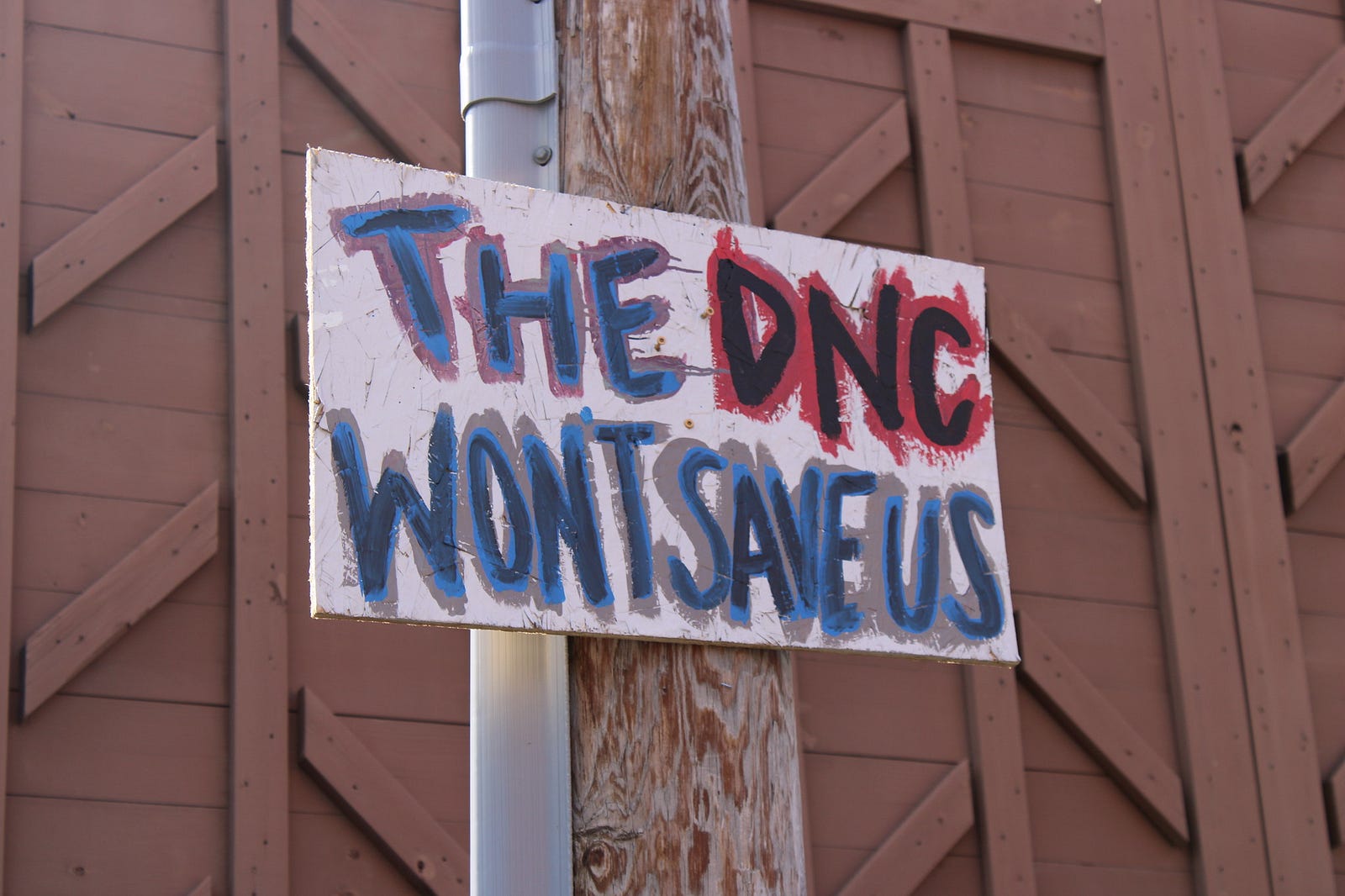
The DNC’s predicament is not fundamentally an organizational dispute. It is a dispute about what the Democratic Party is for.
Is it a broad center-left coalition seeking incremental gains? Is it an instrument for democratic-socialist transformation? Is it primarily the institutional opposition to Donald Trump? Or is it a governing party that must persuade voters who do not already share its cultural assumptions?
No chairman can answer all four questions simultaneously.
Martin’s probable replacements illustrate the problem. Former Wisconsin Democratic chairman Ben Wikler might communicate better and rebuild relationships with major donors. Former Maryland governor Martin O’Malley could provide experience and a familiar national presence. Nebraska Democratic chair Jane Kleeb might preserve Martin’s support among state parties. A finance veteran such as Gifford could reassure megadonors.
But each choice would merely favor one constituency over another.
A donor-friendly chairman would be denounced by socialists as an agent of corporate power. A progressive chairman would frighten the donors upon whom the DNC depends. A state-party chairman might continue shifting resources away from Washington but struggle to become a national spokesman. A prominent moderate would immediately face demands to denounce Democratic primary winners who advocate policies that are unpopular outside the deepest-blue jurisdictions.
In other words, they would each suffer the same fate as Ken Martin.
Failure.
The party’s most famous figures will probably avoid the position altogether. Pete Buttigieg sought the chairmanship in 2017, when it offered an obscure mayor a route to national prominence. He has little reason to seek it now. Kamala Harris would regard it as a demotion. Alexandria Ocasio-Cortez derives much of her power from pressuring the Democratic establishment. Becoming responsible for that establishment would force her to raise money from wealthy donors, remain neutral in primaries and defend candidates far more moderate than she is.
Why would any prospective presidential candidate volunteer to referee a fight in which every decision alienates half the party?
Broad coalitions have always contained disagreements. Democrats once accommodated segregationist Southerners, Northern liberals, industrial unions and urban political machines. More recently, they balanced Wall Street donors, environmentalists, minority voters, suburban professionals and organized labor. Political parties survive such contradictions through compromise: every faction accepts less than it wants because winning part of its agenda is preferable to losing everything.
The difference today is that compromise itself has become suspect within the Democratic activist class.
Incremental gains are dismissed as cowardice. Bipartisan agreements are treated as betrayal. The need to persuade swing voters is sometimes viewed not as a democratic obligation but as an illegitimate concession to people with supposedly backward beliefs.
Positions developed in activist organizations and elite cultural institutions are presented as moral imperatives, leaving no room whatsoever for disagreement over immigration, policing, taxes, Israel, gender or the limits of government.
A Democrat who questions abolishing police departments, decriminalizing border crossings, imposing wealth caps or publicly financing political campaigns may not receive an argument from the activist left. He may instead be told that his position is racist, reactionary or purchased by corporations.
That posture works better within a movement than within a governing coalition. Movements reward conviction. Governments require negotiation, prioritization and the ability to accept partial victories.
A party capable of winning a Democratic primary in Brooklyn is not necessarily capable of winning a Senate race in Pennsylvania — or governing a country of 340 million people who did not all attend the same seminars or adopt the same vocabulary.
Meanwhile, the Democratic establishment has its own credibility problem. Wealthy donors and professional consultants cannot simply lecture voters about pragmatism after presiding over expensive defeats, declining working-class support and a 2024 campaign whose spending remains a source of resentment. Martin’s disastrous election autopsy compounded that distrust by appearing more interested in avoiding uncomfortable conclusions than learning from them.
The establishment demands party discipline without demonstrating that its strategy still works. The socialist wing demands transformation without demonstrating that its agenda can command a national majority. Both sides believe the other is responsible for the party’s failures. Neither recognizes the authority of a chairman to settle the matter.
Martin’s current survival strategy is to run out the clock. State-party leaders are reluctant to begin a destabilizing leadership contest before the midterms. Hakeem Jeffries has given him public support. No consensus successor has emerged. If Democrats win the House in November, Martin will claim that his investment in state parties produced the victory. If they lose, his chairmanship may not survive the winter.
But Martin’s departure would settle only the personnel question.
His replacement might repair donor relationships, appear more frequently on television and manage the DNC with greater transparency. Perhaps the next chairman will even refrain from throwing office equipment. All of that would be welcome.
It would not answer the central question.
The Democratic Party must decide whether its purpose is to govern an imperfect country or transform it without compromise. Until it does, its chairman will remain responsible for maintaining unity among factions that increasingly do not want the same party.
(Contributing writer, Brooke Bell)